


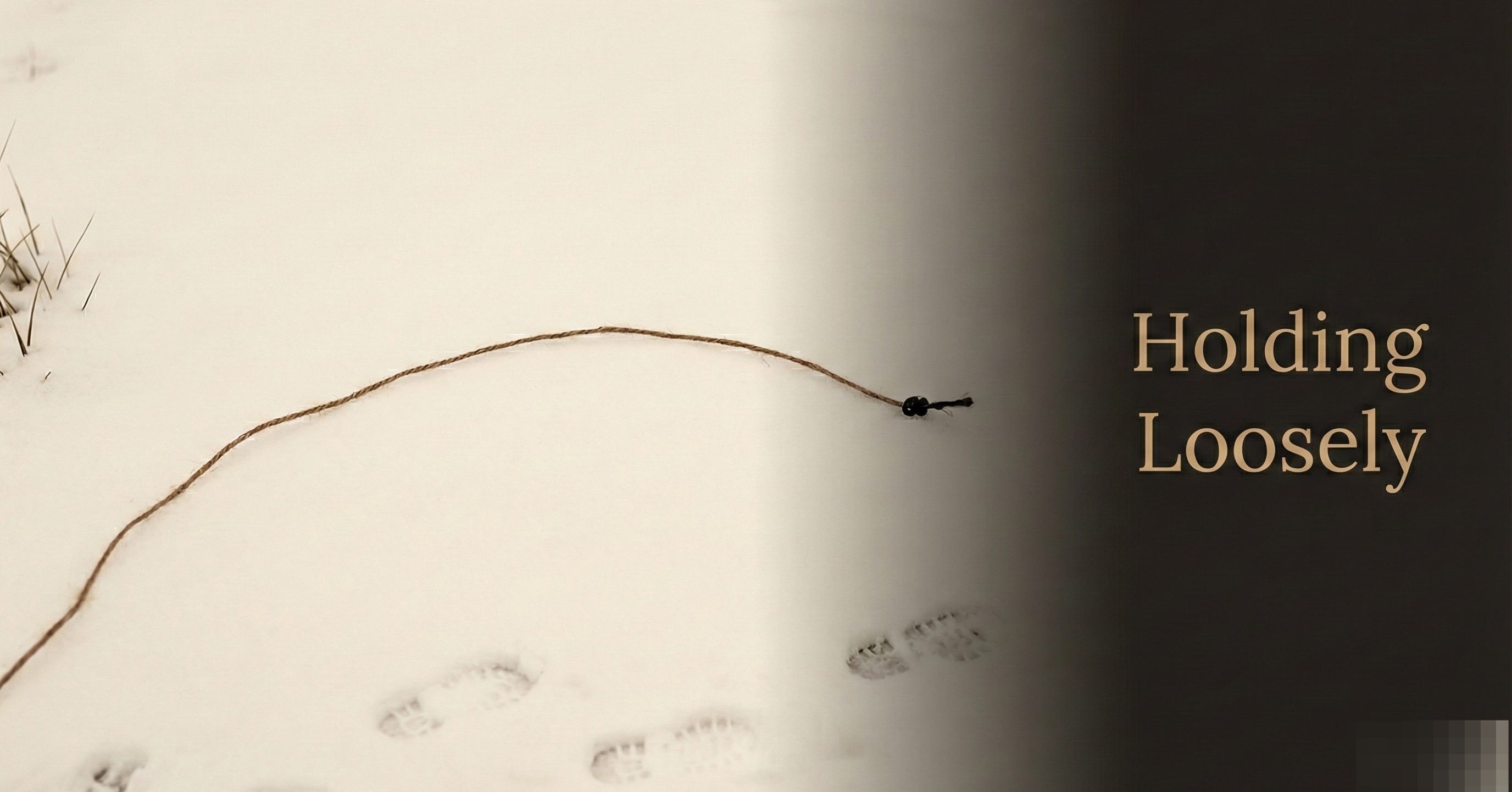
Wells found a stick on a hike a few weeks ago. Not an unusual stick. A stick. But it came home with us, and it has lived in the backyard ever since, serving whatever purpose the moment requires. Some days he carries it around narrating a story I can’t follow, waving it at things only he can see. When the snow came, it became a fishing pole. He stood knee-deep in a drift, casting his line into a frozen lake that exists only in his head, pulling up fish after magnificent fish.
At some point he found a special place for it in the backyard. Tucked it away where he could return to it, pick it up again whenever he wanted.
For the last six weeks, I’ve been doing something similar. Tucking a few ideas into place, ideas we’ll keep returning to.
We started with a confession: you’re exhausted, and the exhaustion isn’t a character flaw. It’s the weight of living like you own a life that was never yours to own.
Then I gave you a definition: Stewardship is faithfully tending everything God has entrusted to you as worship, as mission, as formation. Not a church word about budgets. A framework sturdy enough to hold the actual weight of your life.
We named three lies that keep you grasping — performance, control, scarcity — and the root lie underneath all of them: that you’re the source. The provider. The one keeping it all together.
Then we went to the cross. Because without it, “God owns everything” is cosmic landlord theology. With it, it’s a rescue story.
We asked the hardest question last: what survives? What are you actually building toward? Three things last — community, character, communion — and most of what we’re grasping so tightly doesn’t.
And last week, I released Chapter 1. A bit of the book itself, or at least the beginning of it, in your hands.
That’s the map. But a map isn’t the territory. Knowing that stewardship matters doesn’t tell you what to do when you’re staring at a bank account that doesn’t add up, or sitting in a job that takes more than it gives back, or waiting on test results for someone you love.
Now I want to go deeper.
This newsletter can sit with one idea for a thousand words. It can chase a thread the book only has room to mention and give it the space it deserves.
Here’s what I mean. In 1 Corinthians 15, there’s this Greek word — kopos — that references the kind of labor that leaves you hollowed out at the end of the day. Not generic work. Exhausting, costly toil. And even that labor is not in vain. The promise reaches all the way down to the work that empties you. Which means everything above it counts too.
I kept coming back to that verse. It changed how I think about the job I lost, the book I’m writing in between job applications, the parenting that demands everything and explains nothing. I want to show you why.
That’s what this newsletter becomes from here. A companion to the book. Some weeks it’ll be a passage like that one. Other weeks a painting, a philosopher, or a story from my life that left a mark. The place where I bring you what I’m finding and we sit with it together.
Every week, it’ll be honest. And it’ll be aimed at the same thing: what does it look like to hold your life loosely, faithfully, in a world that rewards the opposite?
This week’s practice:
No practice this week. Just a question.
Of everything we’ve covered so far, what landed? What’s the idea or the phrase you keep coming back to?
Hit reply and tell me. One sentence is enough. I read every response, and your answer will shape what I write next.
Seven weeks in. Thank you for reading these on a Thursday morning when you have a hundred other things pulling at you. I don’t take that lightly.
More next week,
Rex
P.S. — If you haven’t had a chance to grab Chapter 1 yet, it’s still available for $1.
[GET CHAPTER 1 →]