


We tried for five years to have kids.
Rachel and I knew from early on that we wanted children. But “wanted” is a slippery word. For most of our marriage, what we meant was: someday. Not now. The timing wasn’t right. We weren’t ready. We had things to figure out first.
I don’t know exactly when “someday” became “now.” I think it had already happened in the background at some point while we were focused on other things. But I remember the moment the fear arrived, because it was sharp.
We’d been trying for over a year with nothing. Then two. Then we were sitting in a fertility clinic, and the doctor was explaining options, and I was listening with one ear while the other was tuned to a frequency I couldn’t quite name. Something between prayer and panic.
I wasn’t sure I wanted to hear God’s answer.
Not because I didn’t trust him. Or maybe exactly because of that. I’d been taught that God is good, that his plans are for my flourishing, that he knows what I need better than I do. I believed all of it. In theory.
But when you’re three years into asking for something and the silence stretches, theory gets tested. And what I found underneath my theology was a tangle of questions I couldn’t untie:
If I keep praying for this, am I making a faithful request, or am I just pushing my own agenda and calling it prayer?
What if wanting this so badly is the problem? What if I’m supposed to let go, and I just can’t?
Is there a “reason” this hasn’t happened? And if there is, do I want to know it?
I was paralyzed. Not because I didn’t care. Because I cared so much that the risk of engaging felt unbearable. What if we poured ourselves into this and it didn’t work? What if God’s answer was no, and I had to live with that? Easier, maybe, to keep “someday” alive than to find out.
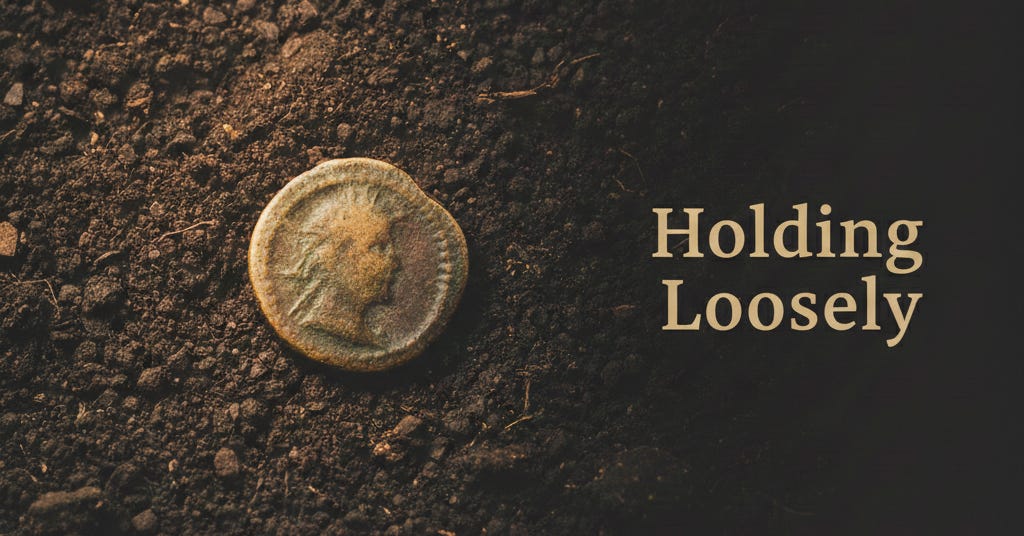
I almost buried the talent.
There’s a parable in Matthew 25 that I’ve been studying for weeks. A master entrusts three servants with money and leaves. When he comes back, two have doubled what they were given. One buried his in the ground.
I grew up hearing this as a story about laziness. Work hard. Use your gifts. Don’t waste what God gave you. That’s not wrong, exactly. But it misses the thing that matters most.
The third servant wasn’t lazy. He was afraid.
He says so himself: “I was afraid, and I went and hid your talent in the ground.” The Greek word the master uses to describe him, okneros, doesn’t mean slothful the way we think of it. It means to hesitate, to shrink back, to lack the resolve to act. Two thousand years of scholarship keep landing in the same place. D.A. Carson puts the causal chain in a single sentence: “Because he didn’t know him, he didn’t trust him. Because he didn’t trust him, he did nothing.”
The servant had built a god in his head. A hard master, impossible to please, ready to punish. And that false god produced exactly the response such a god would deserve: self-protective withdrawal. He couldn’t risk engagement because he was convinced the master would crush him for failing. So he buried what he’d been given and handed it back untouched.
Here. You have what is yours.
Scholars hear passive aggression in that line. Not trembling humility. Resentment. He’d constructed a theology that justified his refusal to try, and he was daring the master to prove him wrong.
But the master wasn’t hard. Look at the evidence inside the parable itself.
He entrusts astronomical sums without micromanagement. One talent alone equals roughly twenty years of a laborer’s wages. He calls five talents “a few things.” He gives no explicit instructions, trusting the servants to act within the spirit of the assignment.
And when they return, the servant who earned five talents and the servant who earned two receive identical, word-for-word praise:
Well done, good and faithful servant. You have been faithful over a few things; I will set you over many things. Enter into the joy of your master.
Not “well done, you produced the most.” Not “well done, your yield was higher.” The same words. The same welcome. The same invitation into joy. What mattered wasn’t output. It was whether you engaged at all.
The master wasn’t looking for a return on investment. He was looking for trust.
I want to be careful here.
We tried for five years. In 2022, after multiple rounds of fertility treatment, our son Wells was born. Brynn came after. We got a yes.
But this is not a story about outcomes. I know people who prayed just as long, tried just as hard, and got a different answer. I have no theology that explains why we hold our children and they hold grief. I won’t pretend that our yes validates the asking.
And yet I almost let fear make the decision for me. Fear had built a version of God in my head — not one who might say no, but one who might say nothing. A God who wasn’t even interested. A God I couldn’t trust with the asking.
That God wasn’t real. The real one, the one who entrusts and invites and says enter into my joy, could be trusted with the question. Even in the silence.
The shift wasn’t from doubt to certainty. It was from burying to trading. From protecting myself against a hard master to engaging with a generous one. We opened our hands and let God be God with the thing we wanted most.
The condemned servant wasn’t the one who tried and failed. There is no servant in this story who tried and failed. The only one condemned is the one who never started.
And his problem, underneath everything, wasn’t cowardice. It was theology. He had the wrong God. And the wrong God kept him safe, and barren, and alone.
What you believe about the master determines whether you trade or bury.
This week’s practice:
Where are you burying right now?
Not out of laziness. Out of fear. The prayer you won’t pray because you’re not sure anyone’s listening. The conversation you won’t start. The risk you won’t take because it’s safer to keep “someday” alive than to find out.
Name it. Just one thing.
Then ask yourself: what kind of master am I imagining? A hard one who’s setting a trap? Or a generous one who’s inviting me into his joy?
You don’t have to have it figured out. Just stop burying.
More next week,
Rex